Clearance calculation based on a single sample
Lars Jacobssons originalartikel från 1983 om enprovsmetoden för njurclearance — återgiven ordagrant, avsnitt för avsnitt, med svenska kommentarer och härledningar samt artikelns figurer återskapade.
Lars Jacobsson — Department of Radiation Physics, Linköping Hospital, Linköping, Sweden
(Received 19 July 1982; accepted 14 January 1983)
Om denna version. Originaltexten visas avsnitt för avsnitt i serif-panelerna nedan, ordagrant på originalspråket och med originalets egna rubriker. Efter varje panel följer en svensk kommentar och, där det finns matematik, en härledning — båda tillagda i pedagogiskt syfte. Figurerna är återskapade ur artikelns egna formler; originalfigurerna finns under varje diagram.
Metoden i korthet — en karta inför härledningen
Målet är att räkna ut clearance ur ett enda plasmaprov. Artikeln bygger upp formeln i tre steg:
- Idealformeln. En enkompartmentsmodell ger — det behövs bara dosen, ett prov och en volym.
- Två korrektioner. Verkligheten avviker på två sätt: extra tidig elimination innan blandningen är klar (hanteras med reduktionsfaktorn ) och en plasmakoncentration som är lägre än genomsnittet (hanteras med och den effektiva volymen ).
- Approximationen som gör den användbar. Eftersom och själva beror på blir formeln cirkulär — tills Jacobsson visar att och bryter cirkeln.
Resten handlar om vad modellen ger tillbaka: känslighet för fel i , förutsägbar osäkerhet och en optimal provtid.
Symboltabell — slå upp beteckningarna
| Symbol | Betydelse |
|---|---|
| injicerad mängd/aktivitet (dos) | |
| kvarvarande mängd i kroppen vid tid | |
| utsöndrad mängd per tidsenhet (positiv) | |
| plasmakoncentration vid tid | |
| extrapolerad koncentration vid | |
| skattad distributionsvolym | |
| effektiv volym i slutformeln, | |
| monoexponentiell eliminationskonstant | |
| terminal lutning i flerprovsmetoden | |
| okorrigerat enkompartments-clearance (“one-pool”) | |
| reduktionsfaktor för effektiv startdos, | |
| korrektion för icke-uniform distribution |
Summary
A formula has been derived for the calculation of renal clearance with the use of a single plasma sample. The formula is based on a one-compartment model. A small correction for non-immediate mixing and non-uniform distribution of the tracer was calculated from empirical data. The accuracy in the calculation method depends on how exactly the distribution volume is known and at what time the blood sample is taken. The expected standard deviation in the clearance value was calculated from data of mean value and spread for the distribution volume of . In an investigation of 39 subjects with , a standard deviation of 5 to 6 ml/min was obtained in comparison with a standard method for clearance calculation. This value is in good agreement with the expected one.
Jacobsson presenterar en formel som beräknar njurclearance ur ett enda blodprov, byggd på en enkompartmentsmodell med två små empiriska korrektioner. Noggrannheten styrs av två saker: hur väl man känner distributionsvolymen och när provet tas. I en valideringsstudie på 39 patienter med ⁹⁹ᵐTc-DTPA blev avvikelsen mot en etablerad flerprovsmetod bara 5–6 ml/min — i god överensstämmelse med vad modellen förutsade.
Introduction
It has previously been shown that the tracer concentration in a single plasma sample taken 3-5 h after the injection is correlated to the renal clearance (Tauxe et al., 1971; Fisher & Veall, 1975; Dakubu et al., 1980). Recently, Groth and Aasted (1981) have derived a nomogram and a formula based on a comparison between the tracer concentration in a single sample and the clearance value calculated according to the Bröchner-Mortensen method (1972).
The formula by Groth and Aasted is empirical and not based on any clearance model. In the present communication, a formula is derived from a simple one-compartment model. With this formula it is possible to take into account different distribution volumes correctly and to determine the optimum time for taking the plasma sample. Further, the expected accuracy in the one-sample method can be determined.
Att ett enda prov 3–5 timmar efter injektionen korrelerar med clearance var redan känt, och Groth & Aasted hade gett ett nomogram för det. Men deras formel var rent empirisk — en kurvanpassning utan modell bakom. Jacobssons poäng är att i stället härleda formeln ur en fysikalisk modell. Det ger tre saker som en ren kurvanpassning inte kan: man kan hantera olika distributionsvolymer korrekt, räkna ut den optimala provtagningstiden, och förutsäga metodens noggrannhet.
Method
The method is based on a one-compartment model. The distribution volume of the tracer is described by the compartment volume . The disappearance of the tracer, caused by the renal excretion, is described by a disappearance rate constant .
Firstly, it is assumed that the tracer is immediately and uniformly mixed in the distribution volume after the injection. After that, a correction for non-immediate mixing is applied and finally the effect of non-uniform distribution is taken into account.
Jacobsson utgår från den enklaste tänkbara bilden: spårämnet sprids i en enda volym och försvinner med en hastighet . Hela artikeln handlar sedan om att lägga till två små korrektioner till denna grundmodell — en för att blandningen tar tid, en för att plasma inte är representativt för hela volymen.
Immediate and Uniform Mixing
According to the definition, the clearance value is given by:
where is the tracer concentration in plasma and is the excreted amount of tracer per unit time.
Assuming uniform and immediate mixing of the tracer in the volume, the following is valid:
(i) The tracer concentration at any time is given by:
where is the amount of tracer.
(ii) The disappearance of the tracer is monoexponential from the injection time and the disappearance rate can be written:
Combining (1) and (2), the clearance value can be written:
and with the use of (3):
is equivalent to the injected amount of tracer.
Avsnittet bygger upp enprovsformeln från grunden: från definitionen av clearance (ekv. 1), via antagandena om direkt jämn blandning (ekv. 2) och exponentiell eliminering (ekv. 3), till det klassiska sambandet (ekv. 4) — som skrivs om så att man bara behöver dosen, ett prov och volymen (ekv. 5).
-
Ekv. 1 — definitionen. Clearance är utsöndrad mängd per tidsenhet delat med plasmakoncentrationen, . Enheten blir ml/min: volymen plasma som renas helt varje minut. Utsöndras 10 mg/min vid 0,1 mg/ml renas 100 ml/min.
-
Ekv. 2 — koncentrationen. Antas spårämnet vara jämnt fördelat i volymen är . är ingen anatomisk volym utan den skenbara volym ämnet sprids i — för DTPA typiskt 15–25 liter.
-
Ekv. 3 — elimineringen. Vid första ordningens kinetik avtar koncentrationen exponentiellt, . Bilda kvoten , logaritmera och lös för : . Konstanten har enheten min⁻¹; halveringstiden är .
-
Ekv. 4 — grundsambandet. Sätt in (exponentiell eliminering) och (ekv. 2) i definitionen: . Clearance är produkten av hur snabbt njurarna eliminerar () och hur stor volym ämnet är utspätt i ().
-
Ekv. 5 — enprovsformeln. Byt ut i ekv. 4 mot uttrycket från ekv. 3 och använd : . Nu räcker dosen , ett prov och en uppskattad volym — men formeln vilar på två antaganden som inte riktigt stämmer, vilket nästa avsnitt rättar till.
Correction for Non-Immediate Mixing
During the first minutes after the injection, before the tracer is completely mixed, the concentration in plasma is greater than during immediate mixing. The greater concentration gives an increased renal excretion which can be interpreted as a loss of tracer activity. The injected amount of tracer, in formula (5), therefore shall be reduced by a reduction factor . The corrected clearance value then can be written:
Den första korrektionen gäller den tidiga distributionsfasen. Innan spårämnet hunnit blandas färdigt — innan det beter sig som en ren monoexponentiell eliminering — är plasmakoncentrationen högre än vad en omedelbar jämn blandning skulle ge. Njurarna filtrerar då bort lite extra spårämne, som senare “saknas” och ser ut som en förlust. Jacobsson kompenserar genom att skala ned den effektiva startdosen med en faktor , så att ersätts av i ekv. 5. Ju bättre njurfunktion, desto mer hinner förloras tidigt — och desto lägre .
Correction for Non-Uniform Distribution
After equilibration, when mixing is complete, the tracer concentration is less in plasma than in the distribution volume as a whole (Chantler et al., 1969). The formula (2) therefore shall be modified to:
where is a factor less than 1. The factor depends on the clearance value, but is supposed to be constant with time after equilibration. The formulas (4) and (6) then will be altered to:
and
where .
Den andra korrektionen gäller att plasma inte är representativt för hela volymen: efter jämvikt är koncentrationen i plasma något lägre än genomsnittet (delvis Gibbs–Donnan-effekten). Att mäta ett för lågt värde är samma sak som att ämnet rör sig i en något större effektiv volym.
-
Ekv. 7 — den lägre plasmakoncentrationen. Inför faktorn : den uppmätta koncentrationen är , alltså bara en andel av vad enkompartmentsmodellen antog.
-
Effektiv volym. Skriver man om som ser man att . Eftersom är — typiskt 5–15 % större.
-
Ekv. 8 och 9 — korrektionen insatt. Grundsambandet blir (ekv. 8), och den fullständiga formeln blir ekv. 5 med båda korrektionerna: i logaritmens täljare och i stället för (ekv. 9). Haken: både och beror själva på — det vi vill räkna ut. Den cirkeln löses längre fram.
Calculation of and
The factors and were calculated by means of two empirical formulas by Bröchner-Mortensen (1980):
and
where is clearance calculated from a one pool-system and is given by:
where is the final slope of the plasma curve, is the extrapolated concentration at time 0, is the calculated distribution volume, and is clearance according to (10), '', with a small correction for different plasma volumes. For a plasma volume of 3000 ml, is equal to ''. In the further calculations, has been approximated to ''.
The reduction factor can be applied on formula (12), which will give a corrected clearance value equal to:
The factor is therefore equal to . By using (10), the factor is obtained as:
The value of is nearly one for low clearance values and decreases to about 0.8 at high values.
Combining (10) and (11), the distribution volume can be written as:
According to (8) and assuming , the modifying factor is given by:
The value of is nearly one for small clearance values and decreases to about 0.85 at high values.
Här ger Jacobsson och konkreta uttryck genom att luta sig mot Brøchner-Mortensens välkända empiri, som översätter ett naivt enkompartmentsvärde till ett korrekt tvåkompartmentsvärde.
-
Ekv. 10–12 — Brøchner-Mortensens empiri. Det naiva enkompartmentsvärdet (ekv. 12) överskattar alltid sanningen, eftersom det ignorerar den snabba fördelningsfasen. Ekv. 10 korrigerar det: . Korrektionen är liten vid låga värden men växer kvadratiskt (−7 % vid , −19 % vid 150). Ekv. 11 ger motsvarande korrigerade volym.
-
Ekv. 13–14 — uttryckt i . Applicerar man på det naiva uttrycket (ekv. 13) och dividerar med ekv. 12 fås . Löser man ut ur andragradsekvationen (10) och sätter in får man . är nära 1 vid låg njurfunktion, ~0,8 vid hög.
-
Ekv. 15–16 — uttryckt i . Kombinerar man (10) och (11) — och förenklar den resulterande rotparentesen till en rät linje, som Jacobsson gör — blir . Jämfört med (och ) avläses direkt — linjärt avtagande från ~0,95 till ~0,82.
Clearance Computation
The formulas (14) and (16) cannot be used directly in the calculation of clearance, as is not known in advance. The following procedure therefore has been used for the clearance computation.
Rearranging (9), the clearance value can be written:
The calculated value of the quotient is shown as a function of in Fig. 1. The value is nearly constant for ml/min and can, with good approximation, be set equal to (ml/min) for all clearance values.
The corrected clearance value then can be written:
The effect of the modifying factor is accounted for by the following procedure: (i) An approximate clearance value, , is calculated according to (18) but with the use of the true distribution volume ; (ii) is calculated according to (16) with the use of ; (iii) The corrected clearance value is calculated according to (18) with the use of .
The error in caused by this procedure is in general less than 1%.
Visa originalfigur (Jacobsson 1983)
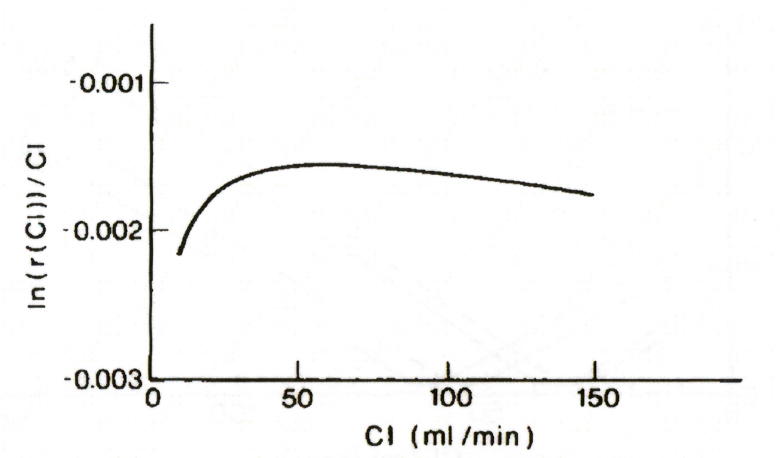
Fig. 1. The quotient ln r/Cl calculated from equation (14).
Det är här metoden hade kunnat fastna — men i stället kommer artikelns finaste steg: en approximation som bryter cirkeln.
-
Ekv. 17 — cirkeln blir synlig. Skriv om ekv. 9 genom att dela logaritmen () och samla . Resultatet innehåller termen — alltså på båda sidor. Normalt en återvändsgränd.
-
Figur 1 — den räddande observationen. Räknar man ut kvoten för olika visar det sig att den knappt rör sig: ovanför ml/min ligger den kring −0,0016 (ml/min)⁻¹. Den krångliga, -beroende termen kan bytas mot en konstant.
-
Ekv. 18 — huvudformeln. Med approximationen insatt försvinner ur högerledet: . Det enda som återstår av cirkeln sitter i , och löses med en kort iteration: gissa , räkna , uppdatera och , räkna om. Felet är typiskt < 1 % redan efter ett varv. Det är denna loop som körs i iohexolverktyget.
Räkneexempel: från ett prov till clearance
En patient väger 70 kg. För ⁹⁹ᵐTc-DTPA blir den skattade volymen ml. Ett prov tas min efter injektionen, och dosen delat med den uppmätta koncentrationen ger ml.
Varv 0 — starta utan volymkorrektion ():
Uppdatera: , alltså ml.
Varv 1 — räkna om med nya :
Ett varv till ändrar bara marginellt — slutvärdet är ≈ 80 ml/min.
Dependence on Error in V
The distribution volume is dependent on the type of tracer. It has been shown that the volume corresponds to (SD) % of body weight () for inulin (Ladegaard-Pedersen, 1972). For , the following data has been found: (SD) % (Ladegaard-Pedersen, 1971), (SD) % for males and (SD) % for females (Bröchner-Mortensen, 1980). In this investigation (see clinical application), a value (SD) % was found for . The very large standard deviations found in these investigations implies that the estimation of for an individual is uncertain with up to 50% variation. However, the calculation of clearance according to (18) is fairly insensitive on the precise value of , especially if the blood sample is taken at a proper time.
A calculation of clearance using different values of is shown in Fig. 2. For a clearance value of 100 ml/min and a sample time of 200 min, a 50% error in will give an error in clearance value of less than 15%.
Visa originalfigur (Jacobsson 1983)
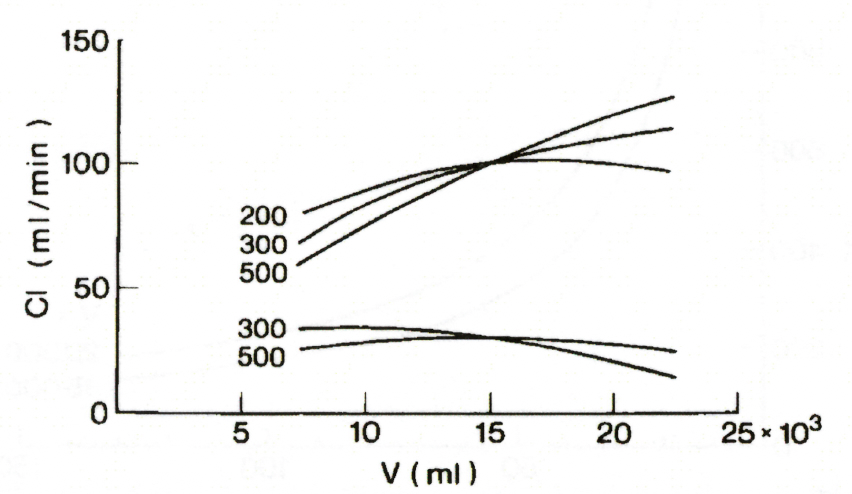
Fig. 2. The dependence of the calculated clearance value, Cl, on the value of the distribution volume, V, for two clearance values, 100 ml/min and 20 ml/min. The curves are valid for the sample time 200, 300 and 500 min after the injection.
Den största osäkerheten i metoden är att vi gissar utifrån kroppsvikten. Figur 2 visar hur mycket det spelar roll: håll den sanna situationen fast (sann ml) och se vad formeln skulle räkna ut om man matar in ett felaktigt . Alla kurvor passerar den sanna punkten; det är lutningen där som är intressant — en brant kurva betyder stor känslighet. Känsligheten är minst när provet tas nära den optimala tiden : vid lågt ligger optimum sent, så ett senare prov hjälper; vid högt ligger det tidigare, så ett för sent prov kan i stället öka känsligheten. Felet är ändå hanterligt — som originaltexten ovan noterar slår även en grov feluppskattning av igenom med klart mindre i clearance, om provet tas nära optimum.
The uncertainty in caused by the uncertainty in was calculated using the above mentioned mean value and standard deviation of for . Fig. 3 shows the results of such a calculation made for two different sample times. The calculated standard deviation, , is thus around 12 ml/min at ml/min and around 4 ml/min at ml/min for a sample time of 300 to 500 min after injection.
Visa originalfigur (Jacobsson 1983)
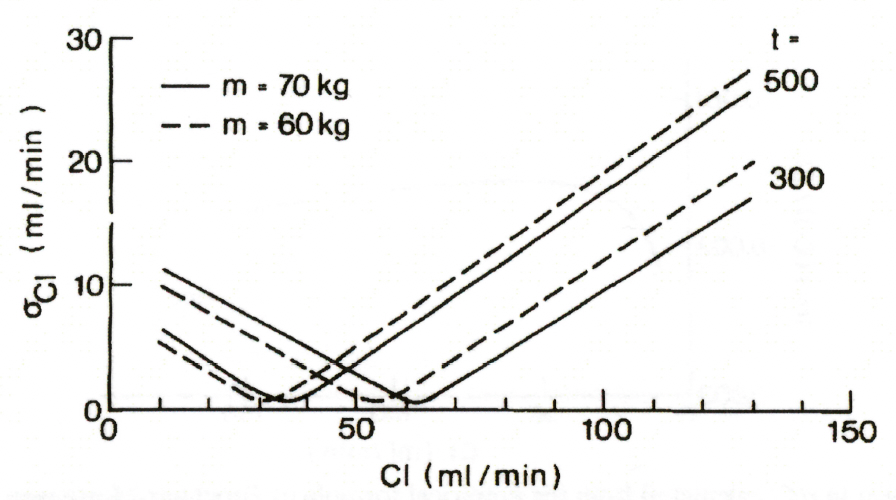
Fig. 3. The expected standard deviation σCl in the clearance value calculated for ⁹⁹ᵐTc-DTPA [V = 24.6 ± 6.9 (SD) % of the body weight 70 kg and 60 kg].
Eftersom man vet hur mycket varierar mellan individer ( % av kroppsvikten för ⁹⁹ᵐTc-DTPA) kan modellen förutsäga standardavvikelsen i svaret. Figur 3 visar denna (en känslighetsskattning från SD): osäkerheten växer med njurfunktionen — kring 4 ml/min vid men omkring 12 ml/min vid (för prov 300–500 min). Varje kurva har sitt minimum där provtiden sammanfaller med den optimala, så ett senare prov hjälper vid låg clearance men inte nödvändigtvis vid hög.
The Optimal Sample Time
The optimal time, , for taking the sample is when the clearance calculation is least dependent on . This happens when the derivative of formula (18) is zero, i.e. when . Fig. 4 shows as a function of for two distribution volumes . For clearance values around 100 ml/min, is about 3 h, and for clearance values around 30 ml/min is about 10 h.
Visa originalfigur (Jacobsson 1983)
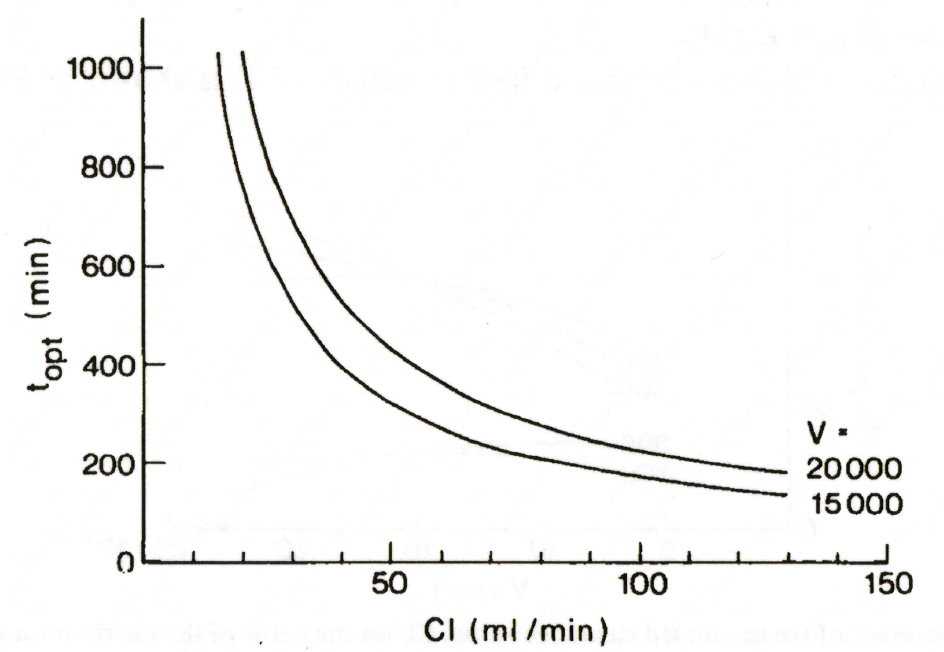
Fig. 4. Optimal time, topt, of blood sampling as a function of clearance value for two distribution volumes, 15,000 and 20,000 ml.
Eftersom modellen beskriver hela förloppet kan man räkna ut när svaret är minst känsligt för fel i — matematiskt där derivatan är noll, vilket inträffar vid . Det är ungefär medeluppehållstiden, och den förskjuts till senare tider ju sämre njurfunktionen är: ~3 timmar vid , men nästan ett halvt dygn vid riktigt låga värden. Praktiskt är det en avvägning — under blir 10 timmar eller mer (sällan genomförbart), men redan att flytta provet från gängse 4–5 timmar till 8 halverar ungefär osäkerheten. Mitt verktyg Optimal provtid (Jacobsson) räknar ut för en patient ur skattad extracellulärvolym och förväntat GFR.
Dependence on Errors in and
The error which appears in for a certain error in or can be written:
The error is nearly independent on the clearance value. For ml, a relative error of 10% in or will give errors of 5 ml/min for min and 3 ml/min for min.
Modellen säger också hur fel i själva mätningarna fortplantas. Deriverar man ekv. 18 med avseende på och får man uttrycket ovan: felet beror på de relativa mätfelen, och minustecknet betyder att en överskattad ger en underskattad . Det fina är att felet är litet och nästan oberoende av clearancevärdet — ett 10-procentigt fel i kvoten (eller i en av variablerna) ger bara ~5 ml/min vid 300 min och ~3 ml/min vid 500 min. Har båda mätningarna oberoende slumpfel kombineras deras osäkerheter kvadratiskt. I praktiken räcker det att hålla kvoten inom ±10 %, vilket betyder att räknetiden i gammaräknaren kan kortas rejält.
Clinical Application
The method was tested on 39 patients, examined with 150 MBq of . Four blood samples were drawn 240, 260, 280 and 300 min after the injection. One millilitre of plasma from each sample was measured in a gamma well counter for 1 min on the day after the examination. From the activity concentration in the four samples, clearance was calculated according to the Bröchner-Mortensen method (1972). The final slope of the plasma curve was obtained by the least squares method and the ‘one-pool clearance’, , was calculated from formula (12). The corrected clearance value was calculated according to formula (10). Clearance, according to the one-sample method [formula (18)] was calculated for the 240 and 300 min samples. The distribution volume used in the calculation was 24.6% of the body mass. This value was obtained as the mean value of the calculated distribution volumes [formula (11)] for the 39 patients.
Fig. 5 shows the comparison between clearance values obtained with the Bröchner-Mortensen method and the one-sample method with the sample time min. The mean difference between the two values was (SEM) ml/min and the standard deviation was 6.1 ml/min. The mean difference between the clearance values calculated from the Bröchner-Mortensen method and the 240 min sample was (SEM) ml/min and the standard deviation was 5.3 ml/min.
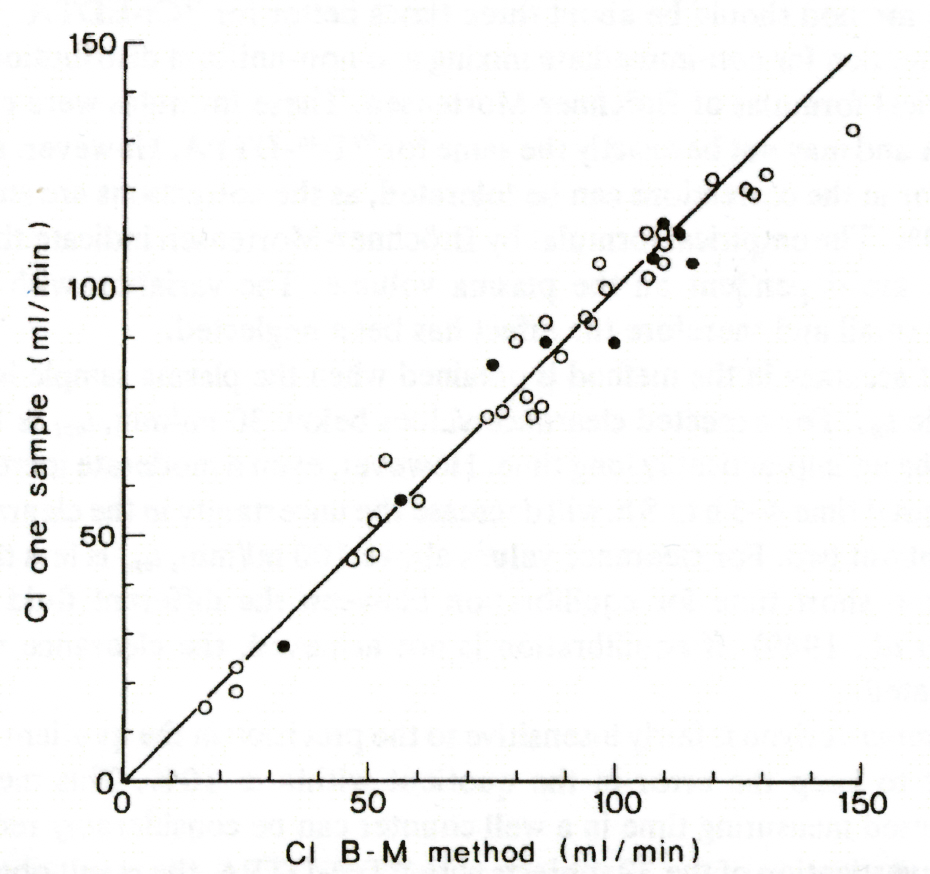
Fig. 5. Comparison of clearance calculated with the Bröchner-Mortensen method and with the one-sample method (sample time 300 min). The investigation was made with ⁹⁹ᵐTc-DTPA. ○ = Solco nuclear, ● = Cea Ire Sorin.
Valideringen jämför enprovsmetoden (ekv. 18) mot en fullständig Brøchner-Mortensen-flerprovsberäkning på 39 patienter. Skillnaden var liten: medelavvikelse 2,3 ml/min och standardavvikelse 6,1 ml/min för 300-minutersprovet — i god överensstämmelse med vad figur 3 förutsade. Värdet 24,6 % för fördelningsvolymen, som hela metoden vilar på, kom just ur dessa 39 personers data.
Discussion
The formula derived for clearance determination with one sample requires that the distribution volume, , is known. The accuracy in the estimation of for an individual determines the accuracy in the method. In this investigation, a great spread was found in the quotient for compared to an investigation with (Bröchner-Mortensen, 1980). If the difference in spread is real, the accuracy in the one-sample method should be about three times better for .
The correction for non-immediate mixing and non-uniform distribution are derived from empirical formulas of Bröchner-Mortensen. These formulas were calculated for and may not be exactly the same for . However, a rather great relative error in the corrections can be tolerated, as the corrections are small, typically less than 10%. The empirical formulas by Bröchner-Mortensen indicate that the values of and are dependent on the plasma volume. The variation with the volume, however, is small and therefore the effect has been neglected.
The best accuracy in the method is obtained when the plasma sample is taken at the optimal time . For expected clearance values below 30 ml/min, is 10 h or more which may be an impracticably long time. However, even a moderate increase from the commonly used time 4-5 h to 8 h, will decrease the uncertainty in the clearance value by a factor of about two. For clearance values above 100 ml/min, is less than 2 h. This may be a too short time for equilibration between the different fluid components (Chantler et al., 1969). If equilibration is not achieved, the clearance value will be underestimated.
The formula derived is fairly insensitive to the precision in the quotient . It is sufficient to keep the error in the quotient within . This means that the commonly used measuring time in a well counter can be considerably reduced.
In the investigation of the 39 subjects with , the result obtained at high clearance values is somewhat better than the predicted one. At low clearance values the accuracy also seems to be at least as good as the predicted one, for the few subjects examined. However, further investigations are needed, with blood sampling at the later time of 8 h or more after the injection to control the reliability of the method at low clearance values.
In summary, the derived formula is useful in calculating clearance using a single sample drawn at any time after the equilibration. Accuracy in the calculation will be improved when a more exact distribution volume is known and with the sample being drawn nearer to the optimal time.
Diskussionen landar i metodens akilleshäl och dess styrkor. Akilleshälen: allt hänger på hur väl är känt. Spridningen i var stor för ⁹⁹ᵐTc-DTPA — för ⁵¹Cr-EDTA, med mindre spridning, borde metoden bli ungefär tre gånger noggrannare. Robustheten: korrektionerna och är måttliga (typiskt under ~10 % vid låg clearance, men 10–20 % eller mer vid hög), och eftersom osäkerheten i själva korrektionerna slår igenom mindre än osäkerheten i tolereras även rätt stora relativa fel i dem; plasmavolymsberoendet kan försummas. Provtiden: bäst nära — men för höga clearancevärden blir den < 2 timmar, vilket kan vara för kort för jämvikt och då underskattas clearance. Slutsatsen: en formel som fungerar för ett enda prov taget när som helst efter jämvikt, och som blir bättre ju närmare optimala tiden provet tas och ju bättre är känt.
Tre felkällor — och en praktisk slutsats
Metodens osäkerhet kommer från tre håll, värda att hålla isär:
- Modellfel — enkompartmentsantagandet, icke-omedelbar blandning, icke-uniform distribution. Hanteras (delvis) av och .
- Fel i — individens verkliga distributionsvolym avviker från den viktbaserade skattningen. Detta dominerar oftast.
- Mätfel i — doskalibrering, provmätning, räkneprecision. Tolereras väl (±10 % räcker).
Praktisk slutsats: metoden är känsligast för fel i , så provet bör tas så nära som praktiskt möjligt. Vid låg clearance betyder det ofta senare provtagning än gängse 4–5 timmar.
Iohexolkalkylator
Teoretisk bakgrund: m, r och den iterativa metoden
Jacobssons enprovs-metod bygger på tre nyckelbegrepp:
- m (volymkorrektion): Efter jämvikt är plasmakoncentrationen något lägre än genomsnittet i distributionsvolymen. Den uppmätta plasmakoncentrationen motsvarar därför en effektiv volym , som är större än eftersom . Faktorn approximeras empiriskt: .
- r (reduktionsfaktor för tidig förlust): Kompenserar för att plasmakoncentrationen är förhöjd innan spårämnet hunnit blandas färdigt, vilket ger extra tidig renal elimination. Den effektiva startdosen skrivs , där , och approximeras med .
- Iterationen: Starta med , beräkna ett initialt med ekv. 18, beräkna , sätt och räkna om . I den approximerade ekv. 18 uppdateras bara och — :s effekt ligger redan i konstanten . Det konvergerar snabbt: en iteration räcker oftast för klinisk noggrannhet, full konvergens inom några varv.
Samma matematik driver enpunktsberäkningen i mitt eget iohexolverktyg — där kan du mata in patientdata och provsvar och få clearance beräknat med Jacobsson-iterationen, med koncentration–tid-kurva och delberäkningar.
References
- BRÖCHNER-MORTENSEN J. (1972) A simple method for the determination of glomerular filtration rate. Scand. J clin Lab Invest, 30, 271-274.
- BRÖCHNER-MORTENSEN J. (1980) A simple single injection method for determination of the extracellular fluid volume. Scand J clin Lab Invest, 40, 567-573.
- CHANTLER C., GARNETT S. E., PARSONS V. & VEALL N. (1969) Glomerular filtration rate measurement in man by the single injection method using . Clin Sci, 37, 169-180.
- DAKUBU S., ADU D., NKRUMAH K. N., ANIM-ADDO Y. & BELCHER E. H. (1980) Single blood sample estimation of glomerular filtration rate. Nucl Med Comm, 1, 83-86.
- FISHER M. & VEALL N. (1975) Glomerular filtration rate estimation based on a single blood sample. Br Med J, 2, 542.
- GRANERUS G. & JACOBSSON L. (1985) Calculation of single injection clearance. Comparison between a single sample and multiple sample formula. Swedish Soc Radiol Proc, 19, 71-73.
- GROTH S. & AASTED M. (1981) clearance determined by one plasma sample. Clin Physiol, 1, 417-425.
- LADEGAARD-PEDERSEN H. J. & ENGELL H. C. (1972) A comparison of distribution volumes of inulin and in man and nephrectomized dogs. Scand J clin Lab Invest, 30, 267-270.
- TAUXE W. N., MAHER F. T. & TAYLOR W. F. (1971) Effective renal plasma flow: estimation from theoretical volumes of distribution of intravenously injected . Mayo Clin Proc, 46, 524-531.
Jacobsson L. (1983). A method for the calculation of renal clearance based on a single plasma sample. Clinical Physiology, 3(4), 297–305. Originalförfattare: Lars Jacobsson, Avdelningen för radiofysik, Linköpings lasarett. Kommentarerna, härledningarna och de återskapade figurerna är tillagda i pedagogiskt syfte.