The Line and the Cloud

A visual guide to regression models
in clinical chemistry

Filip Landgren

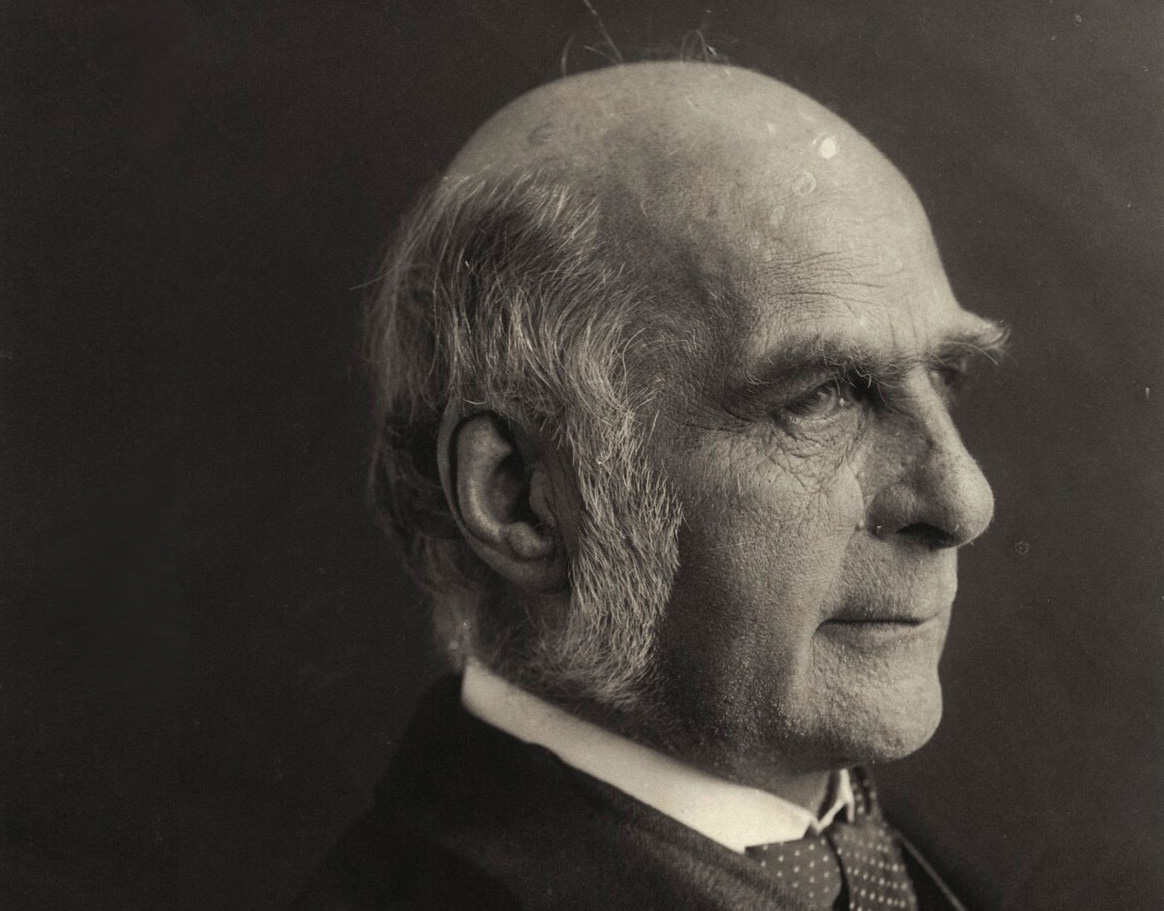
Sir Francis Galton

Sir Francis Galton

1822–1911

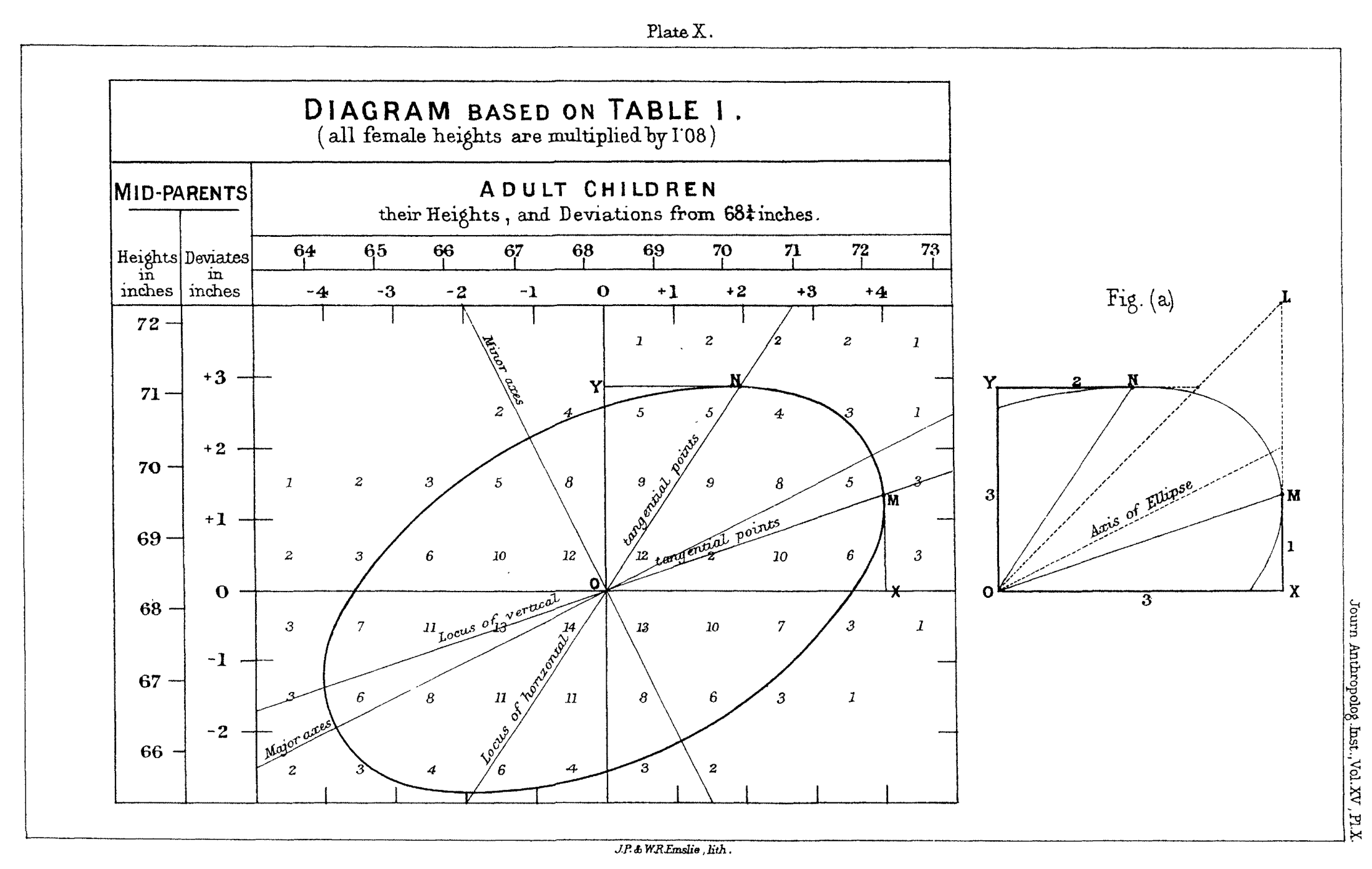
Darwin's half-cousin and a Victorian polymath in heredity, meteorology and statistics. He measured the heights of parents and children, tabulated the frequencies on a grid and saw that the contours formed ellipses.

The shape of the ellipse became his measure of covariation: narrow and steep means a strong relationship. That was correlation, barely a decade before Pearson formalised r (1895–96).

Galton's ellipse

Galton 1886, Plate X: ellipse diagram of the heights of parents and children

Plate X from Regression towards Mediocrity in Hereditary Stature (1886)

What is r?

r describes the shape of the cloud, not a line through it.

Restriction of range

Correlation ≠ agreement

Bland–Altman

OLS: the invisible default

Deming: the principled default

Passing–Bablok: the robust alternative

Regression dilution

Model convergence

The role of regression

Slope ≠ 1: proportional bias

Intercept ≠ 0: constant bias

r measures covariation between two variables and is independent of the regression model.
R² = 1 − SSres / SStot is the proportion of variance the model explains. That R² = r² is a property of OLS, not a general truth.

Can you see a difference?

Regression models have no eyes

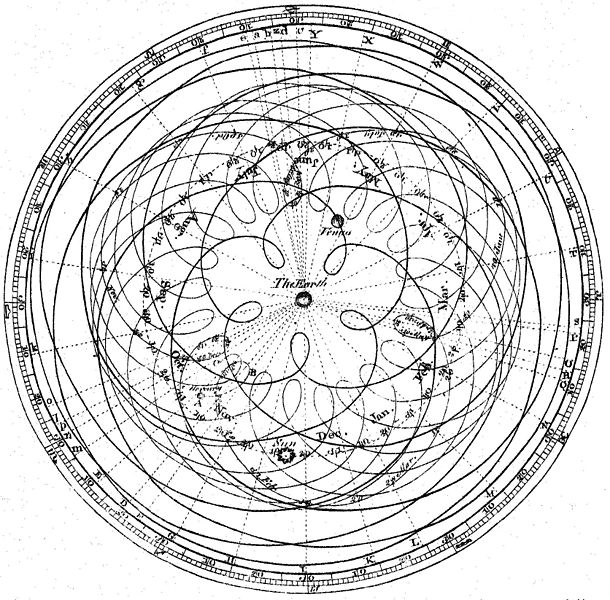
Ptolemy's geocentric model with epicycles

All models are geocentric

Identical statistics can hide entirely different realities, and a model with the wrong assumptions can still predict well.

Ptolemy's epicycles predicted planetary positions with high precision. The ontology was wrong.

"All regression models are geocentric, but not equally geocentric. The assumptions about error structure decide which slope you get."

Heteroscedasticity

Weighted Deming (constant-CV Deming): weight = 1/(analytical variance at that concentration), in practice 1/(estimated concentration)², so that every concentration level contributes equally. The recommended default under constant CV per CLSI EP09c 6.2.2.

Log transformation: take logarithms first so that the scatter becomes constant, fit Deming on the log scale and back-transform.

Passing–Bablok: ranks slopes and needs no weights. Viable under constant CV per EP09c, but requires more samples than parametric methods for the same precision.

Why the choice of model matters

  • r measures covariation, not agreement, bias or interchangeability
  • OLS assumes x is error-free. It never is in a method comparison, and the slope is attenuated.
  • Deming models the error in both axes, which is the correct assumption when two measurement procedures are compared
  • Passing–Bablok is robust, but robustness is not always an advantage. The method does not use imprecision data and rests on a hidden assumption about the error ratio.
  • When the measurement error is small relative to the measuring interval, the models converge, but the error structure decides, not the value of r

"Choose the model by its assumptions, not by convenience."

References

  • CLSI EP09c, 3rd ed. 2018. Measurement Procedure Comparison and Bias Estimation Using Patient Samples. Ch. 6.2 (choice of regression), app. B (weighted Deming), app. G (r and the x range), app. I (Passing–Bablok), app. K (CIs for bias).
  • Linnet K. Performance of Deming regression analysis in case of misspecified analytical error ratio. Clin Chem 1998;44:1024–31.
  • Linnet K. Necessary sample size for method comparison studies based on regression analysis. Clin Chem 1999;45:882–94.
  • Stöckl D, Dewitte K, Thienpont LM. Validity of linear regression in method comparison studies. Clin Chem 1998;44:2340–6.
  • Passing H, Bablok W. J Clin Chem Clin Biochem 1983;21:709–20 (Part I) and 1984;22:431–45 (Part II).
  • Baumdicker F, Hölker U. Stat Probab Lett 2020;164:108801.
  • Galton F. Regression towards mediocrity in hereditary stature. J Anthropol Inst 1886;15:246–63.
  • Anscombe FJ. Am Stat 1973;27:17–21. Matejka J, Fitzmaurice G. Same stats, different graphs. CHI 2017.
  • McElreath R. Statistical Rethinking, 2nd ed. 2020, ch. 4.
"The task is not so much to see what no one has yet seen, but to think what nobody has yet thought about that which everybody sees."

Arthur Schopenhauer, Parerga und Paralipomena (1851)

Thank you

Filip Landgren